
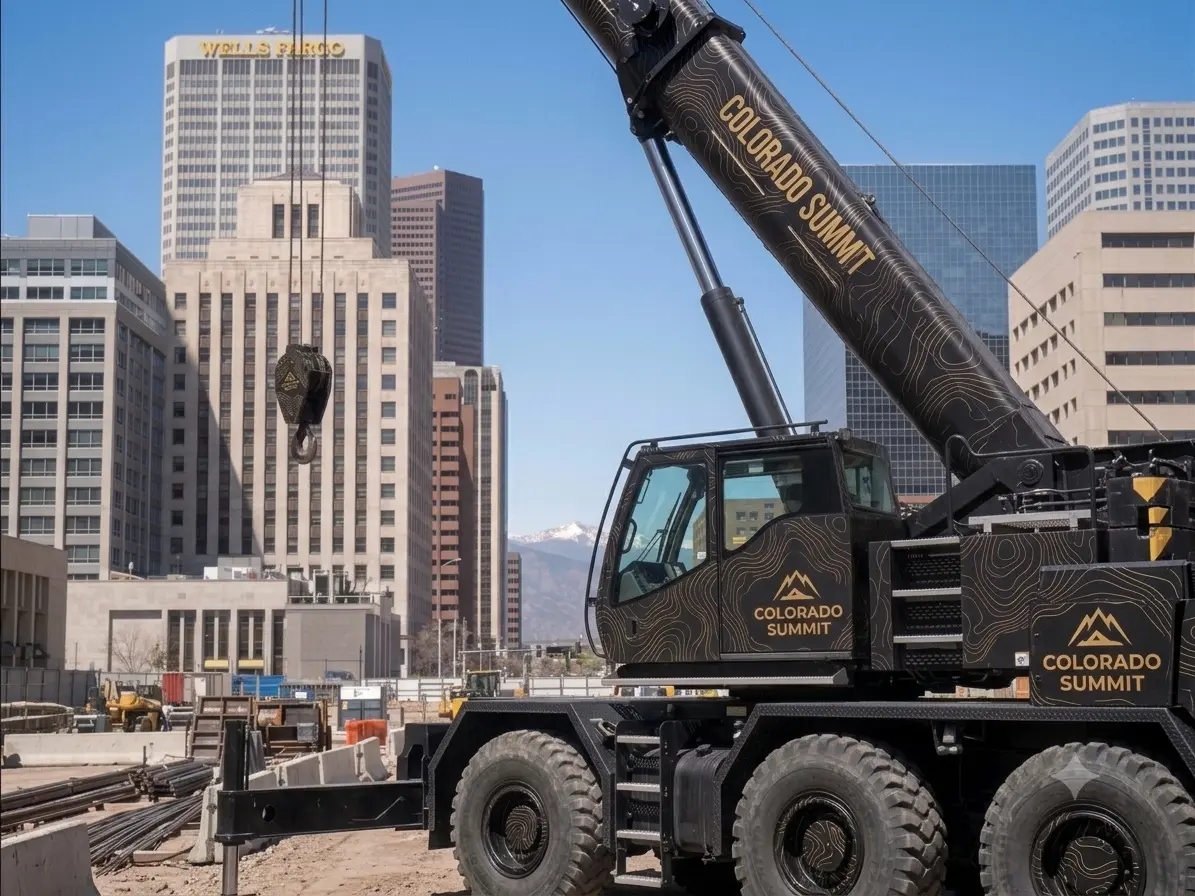
Hard-to-Reach Sites, Planned: Crane Lift Plan in Colorado
Updated: Aug 15
Overview
We wrote this for the person who has to answer for the schedule.
Most lifts need very little of what follows. A rooftop unit on a paved lot in Denver is a phone call, a weight, and a radius. The value of knowing all of this is telling which kind of job you have, so you pay for planning where it changes the outcome and skip it where it does not. What follows covers Colorado's three working regions, how altitude and weather change scheduling, and where each step stops earning its keep.
Table of Contents
The Access Problems Mountain Sites Bring For Heavy Haul Services
How Altitude And Weather Change Every Colorado Crane Lift
The Work We Do Before We Arrive: Rigging Service And Site Prep
What "Ready For Anything" Really Means For You

The Access Problems Mountain Sites Bring For Heavy Haul Services
On most mountain jobs the crane is not the hard part. Getting it to the pad is. A 90-ton machine in a yard is not a constraint; the switchback three miles below your site is, along with the bridge nobody checked and the turnaround that looked generous on satellite imagery. Colorado does not spread these problems evenly, and knowing which one you have is most of the work.
Route Limits, Passes, And Permits Before Oversize Hauling Begins
Start with the mountain corridor and the resort towns: Aspen, Vail, Telluride, Breckenridge, Steamboat, Winter Park.
The hard limits here are written into law. On Independence Pass, between Aspen and Twin Lakes, vehicles and vehicle-trailer combinations 35 feet or longer are prohibited at all times. Not discouraged. Prohibited. CDOT states it plainly on its Independence Pass travel information page. On I-70, the Eisenhower-Johnson tunnel caps height at 13 feet 11 inches and bars hazardous loads, pushing anything taller over Loveland Pass. Route selection is not optional, so it happens before a date gets confirmed. Heavy haul carriers who run this corridor know which bridges force a detour and which county roads will not take a loaded trailer in mud season.
Resort towns then restrict when you can work at all. Vail permits construction seven to seven, Monday through Friday, and Aspen requires an encroachment permit before equipment stages in the right-of-way. Those permits are normally the general contractor's to pull, but the window they create is ours to build around. A pick needing nine hours will not fit one shift once mobilization, setup, and teardown come out of it. Tell us the permitted hours and we will tell you whether the sequence fits. None of which applies if your site sits on a state highway with no municipal layer.
The Front Range fails differently. Denver Metro, Boulder, Fort Collins, and Colorado Springs sit on some of the most troublesome soil in the country. The Colorado Geological Survey's expansive soil and rock hazard overview classifies these clays as a leading geologic hazard statewide, and the practical version is that a pad which felt solid in August will not hold the same outrigger reaction after a wet spring. Add congested lots and lines at the property boundary, and the consequence is a setup problem rather than a route one: the crane cannot sit where the math wants it, radius grows, and capacity drops with it. Permits stack here too, since a state oversize permit covers state highways and nothing else while Denver and Colorado Springs each issue their own. Where ground is backfilled or newly placed and the pick is heavy, a geotechnical opinion is worth having. We do not commission those, but we will ask whether one exists. On an established lot at routine tonnage the question answers itself.
Then the Western Slope: Grand Junction, Montrose, Delta, Rifle, Glenwood Springs. Energy pads reached by unpaved private roads nobody maintains to a standard, plus mud season and culverts of unknown rating. The risk here is distance. On a Front Range job a wrong assumption costs an afternoon; ninety minutes past the last paved road it costs a remobilization. Which is why a site survey is a separate line on a quote rather than bundled into every job. Worth paying for on mountain corridor sites, ground graded within the last few months, and anywhere the staging area is a guess. Not worth it on hardstand we have worked before, at tonnage well inside the chart.
If your work involves heavy hauling, oversize freight, or heavy machinery transport into places like these, the planning side carries more weight than the iron. Our lift planning and site logistics services page covers that scope, and the industries we serve page shows where it gets used hardest.
How Altitude And Weather Change Every Colorado Crane Lift
Altitude is where a lot of well-meaning advice goes wrong. A crane's rated capacity comes from structure and stability: what the boom can carry, and what keeps the machine from tipping. Thin air changes neither. What thin air changes is the engine.
Chain Laws, Storm Windows, And Thin Air On A Crane Rental Colorado Job
A naturally aspirated diesel loses roughly three percent of its power per thousand feet of elevation, and turbocharged engines about half that. The consequence lands on the schedule rather than the load: cycle times stretch and hoist speed drops. The load chart is where the radius-to-capacity trade-off lives, and it does not move with elevation. At Denver's 5,280 feet the effect is real but small. At 9,500 feet it belongs in the day's timing. Below six thousand feet, treat altitude as a footnote.
Winter arrives as a legal condition rather than a weather report. From September through May, commercial vehicles at or above 16,001 pounds must carry chains or approved traction devices on I-70 west of Morrison and most highways west of I-25. That comes from Senate Bill 24-100, and CDOT's chain law guidance for commercial vehicles sets out the corridors and penalties. For nine months, equipment readiness is compliance, and any heavy haul transport through the corridor is covered. Heavy haul trucking companies running it treat October as the start of the planning year. If your job is a boom truck inside city limits, under that weight class and away from a designated corridor, none of it touches you. Cold still does: hydraulic fluid thickens, and the first stretch of a winter morning belongs to warm-up, not production.
Summer runs on a daily clock. The monsoon settles in through July and August, and high-country thunderstorms build with real reliability in the early afternoon. The National Weather Service office in Pueblo maintains a Colorado lightning summary showing the state ranks third in the nation for lightning fatalities across 2006 through 2024, behind only Texas and Florida. A boom is an excellent lightning rod, so high-country picks start at first light and work stops when thunder does. Outside those two months it is not a factor.
Wind does not take a season off, which is why it gets underestimated. No single federal number ends a lift; the manufacturer's chart governs, and most begin restricting operations around twenty miles per hour. What catches people is that force climbs with the square of speed, so a light panel with a large face becomes a different load in a gust than it was ten minutes earlier. On every crane Colorado job the chart is the authority and the measurement that counts is at the load, not the truck, which makes the stop-work call a number rather than an argument. Our about us page covers how crews sit across the Front Range and Western Slope to work inside these windows, the same approach behind every crane rental services Colorado job we quote.
The Work We Do Before We Arrive: Rigging Service And Site Prep
Ground Conditions, Power Lines, And Crane And Rigging Services Checks
Ground bearing pressure is the first question and the one most often waved past. A crane concentrates enormous force through four small contact patches, and the arithmetic is simple: outrigger load divided by allowable soil bearing pressure gives the pad area required, plus a safety factor. Federal rules put the duty to provide adequate ground on the controlling contractor rather than the crane, which lets nobody off. We will not set up on ground that will not hold the reaction, and where the numbers get close, engineered mats go on the quote as their own line. On a firm established pad at moderate tonnage they are unnecessary cost, and we will say so.
Overhead lines get the same arithmetic and none of the flexibility. OSHA's power line clearance requirements set minimums by voltage: ten feet up to 50 kV, fifteen feet through 200 kV, twenty feet through 350 kV, and further beyond. Every line is treated as energized until the utility confirms otherwise. Where the plan brings the boom inside the table, the options are a spotter, a warning line, or de-energizing and grounding, and only the utility can do the last one. We can request it and plan around the lead time. We cannot perform it. Most sites never reach that point, because the setup gets positioned to keep clearance. Underground, locates through Colorado 811 are the general contractor's call, and we ask for confirmation before outriggers go down over anything unpaved.
Then the pick gets worked out: load weight with rigging, center of gravity, radius, boom configuration, swing path, outrigger reactions, percentage of chart. Some version happens on every lift, because it is how the crane gets selected. What scales with risk is the documentation. A 3D model earns its place where geometry is tight, the pick is blind, or the setup has one viable position. A sealed engineer's plan belongs on critical picks, tandem lifts, anything landing on an occupied structure, and the largest classes. A rooftop set at forty percent of chart on an open pad needs neither.
This is standard across competent heavy rigging and heavy lift rigging work, and the same discipline governs construction equipment hauling to and from the pad. Our engineered lift planning services follow this sequence, and the crane lift plan covers how it gets documented before anyone commits a date.
When Must A Signal Person Be Used On A Mountain Pick
Mountain sites create blind picks constantly. A load disappears behind a roofline, drops below grade, or lands where the operator cannot see it. That is the whole test. When are signal persons required comes down to sightlines rather than tonnage. If the operator cannot watch the load through the full arc, a crane signal person directs it, using the standardized gestures that make the exchange identical from Grand Junction to Greeley. The reason hand signals for cranes OSHA publishes are worth knowing is simple: they remove interpretation from a moment where interpretation is expensive. So the answer to when must a signal person be used for a crane is geometry, not paperwork, and on an open lot where the operator sees the load throughout, it does not arise.
Some picks carry a formal label. A lift becomes a critical lift once it exceeds seventy-five percent of rated capacity or requires more than one crane, and a critical pick always gets a written, engineered plan. Tandem work lands there automatically, because two cranes sharing one load introduce a failure mode neither has alone. Most routine picks are nowhere near it, which is exactly why the threshold exists.
What "Ready For Anything" Really Means For You
On the jobs that need it, preparation is a cost you pay early or four times over. On the jobs that do not, it is overhead.
Why Heavy Equipment Hauling And Operated Lifts Lower Your Risk
Run the numbers on a lost lift day. The crane bills whether it lifts or not. Your steel crew stands around and the pour behind them moves. Permits expire, escorts get rescheduled, and a remobilization lands on a budget with no line for it. One soft pad found on arrival moves a schedule a week, and further out west, where the fix is not a phone call.
The safety math points the same way. NIOSH identifies contact between a crane and an energized power line as the most common cause of fatalities in mobile crane operations, and its published findings on crane electrocutions show how consistently these trace back to clearances never established beforehand. Ground failure follows the same pattern. Both are planning failures in operational clothing.
This is also why we run operated only. Every pick comes with a certified operator and signal person, never bare iron handed over at the gate. Our operated rental versus bare rental explanation sets out what changes. Practically, responsibility for the plan, the clearances, and the execution sits in one place, with one point of accountability from quote to invoice, plus the documentation your insurer will ask for.
So here is the short version. Three questions sort your lift. How heavy is it against the chart. Can the operator see the load through the whole arc. Is the ground known, or assumed. Comfortable on all three and you need a competent crew and an accurate address, nothing more. Uncertain on any one and that is where a survey, a model, or a sealed plan pays for itself. Anything beyond that is somebody selling you insurance against a risk you do not have.
Which is where procurement decisions get made. A search for a rigging company near me returns plenty of names, and comparing crane and rigging companies on rate alone is the least useful version of it. Same with rigging services near me and heavy equipment transport near me: proximity matters, since travel bills portal to portal, but a closer yard that skips a survey you needed is not cheaper. Contractors weighing heavy haul companies and heavy equipment hauling services usually find accountability outweighs the number on the sheet. Most useful tips for renting a crane say the same: describe the site honestly, and early.
Final Thoughts
The pass restrictions are published and the chain law dates are fixed. The clearance table has not changed, the soil behaves the way the geology says it will, and the storms build when they always build. Very little about a Colorado mountain lift has to be discovered on the day. What separates a lift that holds its date from one that slips is almost never the crane. It is whether the handful of things that applied to your site got settled in time.
We dispatch from Delta, so a Delta crane reaches most Western Slope sites inside the same week, and the Front Range and mountain corridor run from there. Northern Front Range work, cranes Denver scopes included, moves through the same sequence. Colorado Summit Cranes applies one process across all of it, because the rules do not change at the county line. Only the specifics do.
Send us the load weight, the radius, the height, the address, and your target date. We will tell you what the site needs, and just as usefully, what it does not. Start with our request a quote page and we will work through it.
_edited.png)


Comments