
Mobile Crane Rental Terms & Types Explained Simply
- 5 days ago
- 9 min read
Overview
This is a plain-English glossary of the crane terms you'll run into when you rent one. We built it so you can read a quote, understand what you're paying for, and know which type of crane fits your job — without a background in rigging.
It's organized so you can scan it. Each term gets a short, direct explanation, grouped by where you'll actually meet it: the crane types, the quote, the physics of the lift, and the rigging. Jump to the section you need, or read it top to bottom once and keep it bookmarked.
It's useful for general contractors, project managers, facility managers, and anyone signing off on a lift who wants to know exactly what the words mean before the crane shows up.
Table of Contents
The Types Of Cranes You'll Actually See On A Job Site
The Words You'll See On Every Crane Lift Quote
What Crane Parts Like Capacity And Radius Really Mean
The Rigging Service Terms That Trip People Up

The Types Of Cranes You'll Actually See On A Job Site
The industry has dozens of crane names, and no single post covers them all. These are the types of cranes that show up most often on the projects we handle across Colorado, so they're the ones this guide focuses on. One rule connects all of them: every crane trades reach for weight — the further it reaches, the less it can lift.
From Boom Truck To Crawler Crane: Mobile Cranes Basics
What is a crane — at its simplest, a machine that lifts a load and places it somewhere a person or forklift can't reach. Everything below is a variation on that idea.
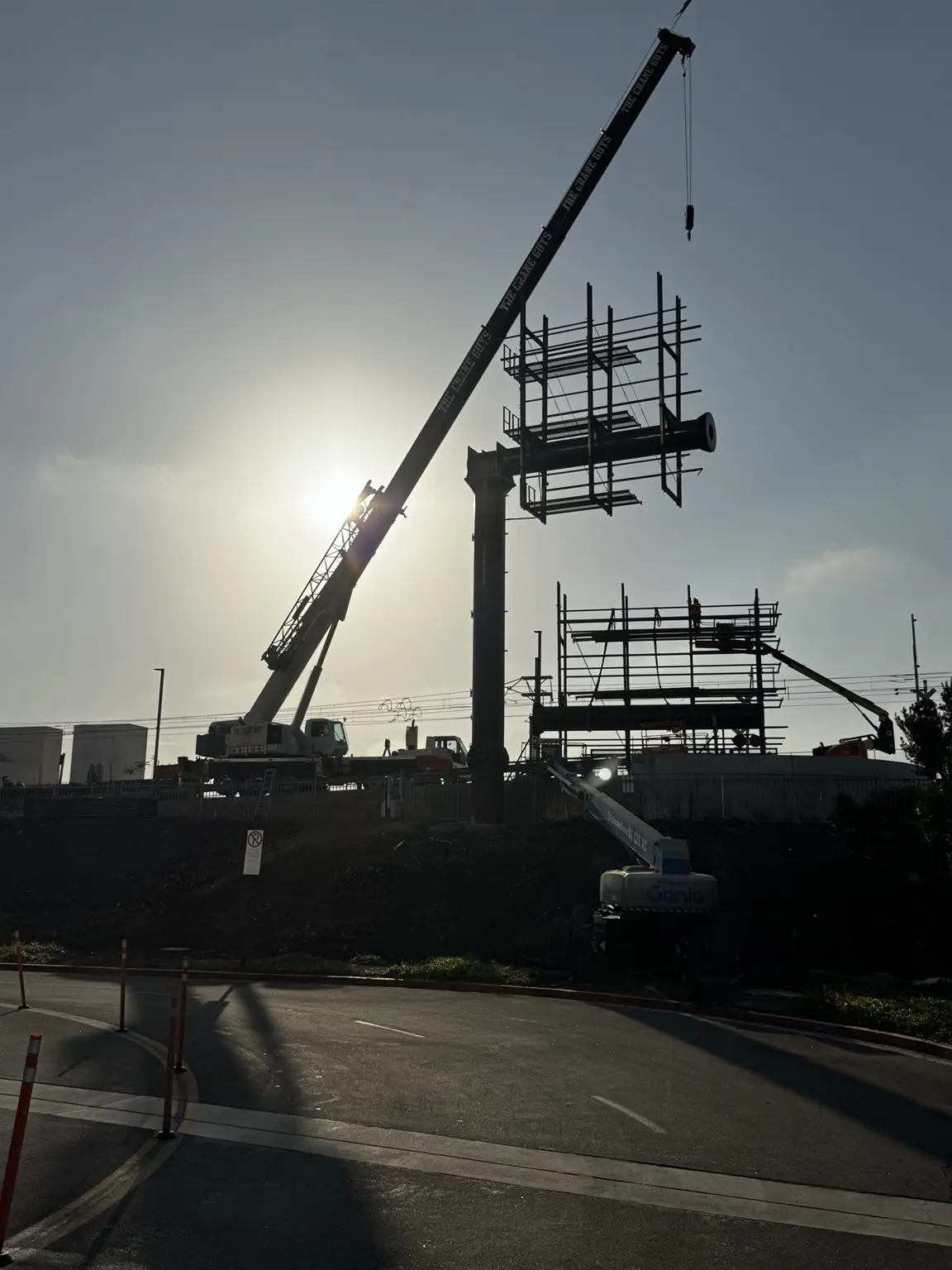
Boom Truck — a crane mounted on a standard truck chassis. It drives to your site under its own power, sets up quickly, and handles everyday lifts like rooftop HVAC units, small steel, and roofing material. Most boom trucks sit in the 30–40 ton range and cover a large share of routine commercial work.
Truck Crane — closely related, and often used to mean the same thing: a crane carried on a truck-style chassis so it can drive the road and lift on arrival. The label matters less than the capability — it comes to you, sets up, and lifts.
Crawler crane — a crane that moves on tracks instead of wheels. It's built for heavy, complex, multi-day picks: critical steel, large tank sets, and lifts a wheeled crane can't safely hold. If you're wondering what is a crawler crane doing parked on a site for a week, that's it — heavy work, slow to relocate, stable under load.
Mobile crane — the umbrella term for any crane that travels to the job rather than staying fixed like a tower crane. When a quote says crane mobile crane or just "mobile," it means the machine comes to you. Understanding how do cranes work as a group — reach vs. weight, wheels vs. tracks, drive-there vs. haul-there — is most of what you need to read a quote correctly.
You can see the classes we own and operate in our Services section, and our Industries We Serve overview matches crane types to the kind of project they belong on.
Rough Terrain Cranes, All Terrain Crane & Carry Deck Crane, Explained
Rough terrain crane — built for dirt, grade, and mud. Big rubber tires, a single cab, and the stability to work on unfinished ground where a road crane would sink. A crane rough terrain setup is common on Western Slope energy sites, and most rough terrain cranes fall in the 50–90 ton range, handling the bulk of industrial lifting.
All-Terrain Crane — a crane that can legally travel the highway at speed like a truck, then work off-pavement like a rough terrain unit. That dual ability is the point. All terrain cranes cover the widest span of capacities — roughly 110 tons past 500 — so they appear on the largest vertical builds and the longest hauls.
Carry Deck Crane — a compact crane that carries its load on a flat deck and works in tight spaces: inside a plant, on a congested urban lot, anywhere a full-size crane won't fit. It belongs to the pick and carry cranes group, meaning it can lift a load and move with it.
Lattice Boom Crane — a crane whose boom is a web of steel cross-members instead of a solid telescoping tube, built for maximum strength on the heaviest lifts.
Off Road Crane — often just a rough terrain machine described by where it works, rather than a distinct class.
Boom — the long arm that reaches out and up to do the lifting; a telescoping boom slides out like sections of a ladder, a lattice boom is the steel-web version above.
Jib — an extension added to the end of the boom for extra reach or height when the boom alone can't get there. It's the piece that gets a load up and over an obstacle on the last stretch of a pick.
The Words You'll See On Every Crane Lift Quote
A crane lift quote assumes you already speak the language. Here are the line items you'll most often see, in plain terms — a real quote is always built to your specific scope, so yours may include more.
What You're Actually Paying For
Portal-to-portal — the clock starts when the crane leaves our yard and stops when it returns, not when it reaches your site. A crane dispatched from an hour away means an hour of billed travel. It's the single biggest reason two quotes for the "same" lift look different — a closer yard is a cheaper lift.
Mobilization ("mob") — the round trip to bring the crane to you and back.
Minimum — the smallest billable block. Most sub-90-ton classes carry roughly a two-hour floor, because no crane rolls out for fifteen minutes of work.
Fuel surcharge — a percentage added to labor, applied by nearly every operator in the country.
Standby time — the crane on your site, crewed and ready, but not lifting, usually because another trade is running late or the weather turned. It's still billed, because the machine and operator are yours for the day. Staging your loads and confirming access keeps it low.
Operated rental vs. bare rental — an operated rental means the crane comes with a certified operator (and usually the crew to run the lift); a bare rental hands you the machine alone and leaves the operating to you. This is worth checking on any quote, because the two are very different services.
We run operated only — every lift comes with a certified crew, never bare iron.
Owned fleet vs. partner network — some capacity a company owns and dispatches itself; larger classes often come through a vetted partner network under the same company's planning and management. Either way, what you care about is a single point of accountability from quote to invoice.
If your job also involves hauling oversized equipment, transport rules apply. The U.S. Department of Transportation's guidance on when a USDOT number is required explains who must be registered to move heavy loads across state lines. To see these line items built to your actual scope, use our Request a Quote page, and for picks that can't wait, you can call us.
What Crane Parts Like Capacity And Radius Really Mean
Two words drive the price of every lift more than any others, and they're the two most people skip. Knowing the parts of a crane behind them is what separates a confident buyer from a hopeful one.
What Is An Outrigger? And Why Radius Changes The Price
Capacity (rated capacity) — the maximum weight a crane can safely lift in a given setup. The number in a crane's name (a "90-ton crane") is its peak rating under ideal conditions, not a promise it lifts 90 tons everywhere. What it can actually hold depends on the next two terms.
What is an outrigger — one of the extendable legs a crane pushes out and plants on the ground to level itself and stay stable while lifting. Think of a person bracing their feet wide before hoisting something heavy. To define outrigger in five words: the crane's braced feet.
Crane Outriggers and pads — when you see crane outriggers set on large timber pads, the crew is spreading the machine's weight so it doesn't punch through soft ground and tip. Anyone asking whats an outrigger doing on those mats now knows: outriggers and ground conditions are the same safety conversation, which is why the term comes up so often in outrigger construction planning.
Radius — the horizontal distance from the crane's center to the load. The rule that governs everything: the further out the load sits, the less the crane can safely lift. A 90-ton-rated crane is rated 90 tons up close; at the edge of its reach, the safe number drops sharply. So "how big a crane do I need" is usually less useful than "how heavy, how far, and how high" — because those three answers are what actually determine the crane.
Load chart — the manufacturer's grid that ties every radius to a safe capacity. These charts follow the mobile crane safety standard; the ASME B30.5 standard for mobile and locomotive cranes is the document the industry builds them around.
The Rigging Service Terms That Trip People Up
The lift is only half the job. Rigging — how the load connects to the hook — is the safety-critical other half. A rigging service isn't an upsell; it's what makes the load arrive.
Riggers & When Must A Signal Person Be Used
Rigger — the person who selects and attaches the gear holding your load (slings, shackles, hardware) and who knows the load's true weight once all of that is added in. The weight the crane feels is always more than the object alone.
Gross load — the full weight the crane actually lifts: the object plus every sling, shackle, and piece of hardware holding it. It's always more than the "the unit weighs X" number on the spec sheet, and it's the number that has to fit under the load chart.
Crane Signal Person — the person who directs the operator when the operator can't clearly see the load or landing zone. As for when are signal persons required and when must a signal person be used, it comes down to sightlines: blind picks, loads swinging behind a structure, anything the operator can't watch the whole way.
Hand signals — the standard gestures a signal person uses so there's no ambiguity between the ground and the cab. The standardized crane hand signals defined by OSHA are a national vocabulary, so the gestures stay consistent from site to site and state to state. The benchmark certification bodies publish what a certified rigger and a certified signal person are tested on, if you ever want to verify who's on your site. Our About US page covers how these roles show up on every lift we run.
NCCCO — the National Commission for the Certification of Crane Operators, the independent body whose certification is the recognized national benchmark for operators, riggers, and signal persons. When a crew is "NCCCO-certified," it means they've been tested against that standard, not just trained in-house.
Crane Lift Plan: What A Pre-Lift Plan Covers
Crane Lift Plan — the written map of how a pick will happen: crane position, load weight, radius, swing path, where the outriggers land, and what the ground can take. Routine lifts use a software-modeled 3D plan; higher-risk picks get sealed by a licensed professional engineer.
Swing path — the arc the load travels as the crane rotates from pickup to landing. Planning it means knowing what's underneath and around that arc — people, power lines, other trades — before anything leaves the ground.
Site survey — a pre-job visit to check access, ground conditions, and obstacles before lift day. It's especially worth it on freshly graded, wet, or mountain-corridor sites, where what looks fine on a map behaves differently under a crane.
Tandem lift — one load lifted by two cranes working together. It's a genuinely more complex, higher-risk pick that always needs an engineered plan, which is why it sits in critical-lift territory below.
Critical lift — the threshold between routine and high-risk. The OSHA definition of a critical lift sets it plainly: a lift becomes critical once it exceeds 75 percent of the crane's rated capacity or requires more than one crane. The broader framework lives in OSHA's cranes and derricks in construction rules, which govern how compliant lifts get planned and executed.
Final Thoughts
That's the vocabulary. With it, you can read a quote, question a radius, and tell an operated lift from a bare rental without guessing.
Knowing the terms also helps you compare quotes on more than price — you can see who's engineering the lift and planning it, not just quoting iron. That's the standard behind our Why Customers Choose Us reputation and our 30+ Years / 3-States / 100% Safety-First track record.
Whether it's precision work on a Commercial & Industrial site or a critical pick on the Western Slope, these are the same terms we'll walk through with you directly.
When you're ready, Request a Quote and we'll talk through your lift in plain English.
_edited.png)


Comments