
top of page
Call (303) 923-8902

What Is a Boom Truck? 6 Jobs It Handles Best

Aug 15
8 min read

Overview

Most commercial lifts are smaller than the machine people instinctively order for them. Knowing where that line sits is what keeps you from paying all-terrain rates for a rooftop unit, and from booking a machine that cannot finish your pick. What follows covers what these machines are, the six jobs they handle best, what the load chart actually allows, and the point where a heavier class stops being optional.


It is useful for general contractors, mechanical and roofing contractors, facility managers, builders and homeowners placing a single heavy item, and anyone holding two quotes for the same lift that differ by half.


Table of Contents

  • What Boom Trucks Actually Are, In Plain Terms

  • The 6 Jobs A Boom Truck Crane Handles Faster And Cheaper

  • Boom Truck Specs: What A 40 Ton Crane Really Lifts

  • How A Crane Truck Gets Into Sites Bigger Mobile Cranes Can't

  • When A Boom Truck Is The Wrong Call, And What To Use Instead


What Boom Trucks Actually Are, In Plain Terms


Crane Truck, Truck Crane, Boom Truck: One Machine, Three Names

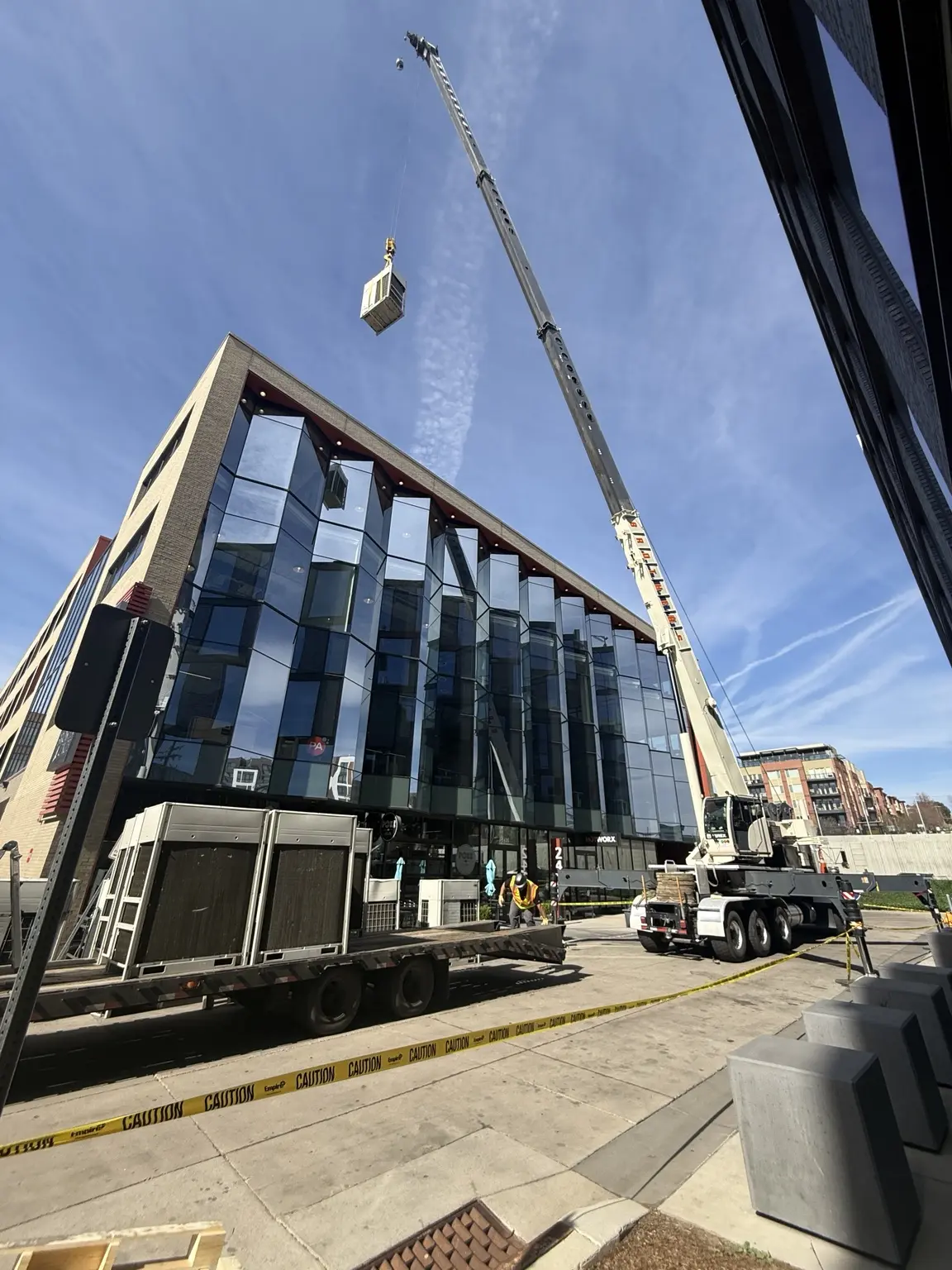
One idea sits under all three names: a crane mounted on a standard commercial truck chassis. It drives to your site on public roads under its own power, sets its outriggers, and lifts. No lowboy. No assist crane. No separate loads of counterweight arriving behind it.


That last point is the definition. Machines in this class carry little or no dedicated counterweight, which limits what they hold and is exactly why they arrive ready to work.


The naming varies by catalog. The same unit appears as a truck mounted hydraulic crane, a hydraulic crane truck, a boomtruck, or a mobile crane truck. Nothing changes but the spelling.


For mobile crane classification, the certification side settles it cleanly. The body that credentials mobile crane operators splits telescopic cranes into fixed-cab and swing-cab designations, and fixed-cab is the boom truck designation. Different exam, different machine, different specification.


So whats a boom truck in one line you can use at a bid meeting: a telescopic crane that stays road legal. Everything below follows from that.


There is a simple test. If it has to be hauled in on a trailer, it is not this class. Our plain-English glossary of crane rental terms puts every class side by side, and our crane and rigging services page shows which ones we own and operate.


The 6 Jobs A Boom Truck Crane Handles Faster And Cheaper


Jobs 1–3: Rooftop HVAC, Roofing Material, And Small Steel On A Construction Boom Truck

Job one is rooftop HVAC. A condenser or chiller onto a one- to three-story building sits well inside the chart of most boom truck cranes, and the full visit fits in a morning.


Job two is roofing material. Bundles, rolls, insulation, landed on the deck instead of carried up a ladder for two days. The crane bills a couple of hours. Your roofing crew keeps the two days.


Job three is small steel and trusses. Joists, modest members, truss packages on light commercial work. A jib handles the last few feet over a wall line.


The savings are not the hourly rate alone. A machine in this class deploys its outriggers and is ready to pick in minutes. A large all-terrain arrives in pieces, with counterweight on separate trucks, and the assembly is billable before the hook moves. On a three-hour job, that setup gap can cost more than the lift itself.


Because billing starts when the machine leaves the yard, that difference lands on your invoice directly — our glossary explains how portal-to-portal billing and the two-hour minimum work so you can read a quote properly. You can also see the commercial and industrial work we support, where RTUs, panels, and steel placement sit together on one site.


None of this holds if the unit lands beyond the chart at the radius your setup forces. That threshold comes later on this page.


Jobs 4–6: Signs, Generators, And Residential Sets With A Small Crane

Job four is sign installation, and it gets over-specified constantly. Highway and commercial signage is usually light, but a large flat face catches wind, and force climbs with the square of speed. A gust twice as strong pushes four times as hard. The machine is rarely the constraint. The weather window is.


Job five is generators and mechanical equipment. Standby units, pumps, compressors, rooftop swaps during a shutdown. A small crane rental here beats waiting on a larger unit with a lead time attached to it, and shutdown work is usually scheduled to the hour.


Job six is residential and modular sets. Hot tubs, landscape boulders, sheds, roof truss placement, modular home sections. This is the job most homeowners and small builders assume needs something enormous, and it almost never does. An articulating boom truck folds into driveways where a straight boom would need the whole street.


Anything a small construction crane reaches from a driveway is not a job for all-terrain rates. Our residential and modular crane service covers this placement work, and every lift arrives with a certified operator and signal person. We do not hand over bare iron, and our glossary explains what changes between an operated rental and a bare rental for the party carrying the risk.


Boom Truck Specs: What A 40 Ton Crane Really Lifts


Radius, Outriggers, And Boom Truck Sizes Across The Class

The tonnage in the name applies at the shortest radius, over the strongest quadrant, with everything fully deployed. Nowhere else on the chart.


Move the load out and capacity drops sharply, because leverage works against the machine the whole way. A crane rated at its headline figure close in can hold a fraction of that at full reach. This is why the useful question is never how many tons. It is how many tons, at what radius. Our glossary covers why radius drives the load chart more than any other number.


This is also where a common assumption deserves a straight answer. A bigger crane does not automatically make a lift safer. Safety margin comes from where your pick sits on the chart, not from the badge on the door. A heavier machine parked further back to clear an obstruction can end up working a higher percentage of its own chart than a smaller one set close. Size only buys margin when it buys a shorter radius or a better position, which is why the setup gets planned before the class gets chosen.


Published boom truck specifications show what the upper end looks like. A 40-ton unit from a boom truck manufacturer carries an 80,000-pound rating on a five-section boom reaching roughly 142 feet. Where the class ends above that depends on who you ask, since manufacturers draw the boundary differently. Which is why asking how big is a crane should be gets you nowhere useful. Weight, radius, and height, together, select the machine.


Two more numbers move the answer. Gross load includes every sling, shackle, and spreader bar, so the weight the crane feels is always higher than the figure on the equipment spec sheet. And setup matters: federal crane rules require outriggers fully extended, or deployed exactly as the load chart specifies for the position in use. Partial extension is a separate chart column with lower ratings, not a shortcut. Our glossary explains what an outrigger does and why the pads under it matter.


One Colorado point worth closing. Elevation does not shrink a load chart. Structure and stability behave the same at 9,000 feet as at sea level. Thin air affects the engine — a turbocharger manufacturer puts it near three percent power loss per thousand feet on a naturally aspirated engine. That shows up as slower cycle times. It belongs on your schedule, not your capacity math. We covered how altitude and weather change a Colorado lift in more detail already.


Comparing mobile crane sizes or reaching for a heavy duty boom truck gets simpler once the chart, not the badge, is treated as the specification.


How A Crane Truck Gets Into Sites Bigger Mobile Cranes Can't


Crane Footprint, Legal Weight, And Working From The Street

Access is decided by paperwork as much as by physics.


Colorado sets legal height at 14 feet 6 inches, width at 8 feet 6 inches, and single-unit length at 45 feet. CDOT publishes those limits with the statute citations attached. Inside them, a machine travels like any commercial truck. Outside them come permits, escorts, route surveys, and separate moves for counterweight. That is the real reason a large crane truck costs multiples more before it lifts anything, and why its lead time is measured in days rather than hours.


Because boom truck weight and boom truck dimensions stay inside those figures, a small boom truck reaches alleys, driveways, and rear yards that a multi-axle machine cannot enter. A smaller outrigger spread also lets it set up on part of a lot rather than needing the site cleared. On a tight infill job with parked cars on one side, that is often the whole difference between lifting this week and not lifting at all.


Working from the public right-of-way is the other advantage, and it still requires approval. Denver requires a street occupancy permit with an approved traffic control plan for setups that take a lane. Price that in early. On an established paved lot with room to set up, none of that applies and the whole question disappears.


Mountain corridor work adds its own limits, and our post on hard-to-reach sites covers the route restrictions, passes, and resort-town permits that decide whether a machine reaches your pad at all. Ground is the other assumption worth testing. Lower crane truck weight across four outriggers needs less pad than a heavy class, but the soil still has to hold the reaction, and we set out how ground bearing pressure and pad sizing get calculated in that same post. On hardstand at routine tonnage, that question answers itself too.


When A Boom Truck Is The Wrong Call, And What To Use Instead


Rough Terrain Cranes, All Terrain Crane, Carry Deck Crane, Or Crawler Cranes

Here is where this class stops, and it is worth knowing before you request a quote rather than after.


Four conditions move the job up. The pick approaches the upper reaches of the chart at your required radius. The load must clear a tall obstruction, pushing radius out and capacity down with it. Tip height runs past what a telescopic boom on a truck chassis provides. Or the job needs two cranes, which lands in engineered-plan territory automatically — our glossary explains why a tandem lift is always a critical lift.


On graded dirt, mud, or an energy pad, what type of crane is ideal for rough terrain has one honest answer. Big tires, single cab, built for unfinished ground. rt cranes generally carry the range that handles the bulk of industrial lifting.


When a job needs highway speed and off-pavement capability in the same unit, an all terrain mobile crane does both, at a real cost in permits and lead time. For confined plant and indoor work, a carry deck is a genuine small mobile crane that picks and carries where nothing larger fits. And heavy multi-day picks — large tank sets, critical steel — are what crawlers earn their transport and assembly time for.


Our glossary sets out rough terrain, all-terrain, and carry deck cranes side by side, and our about us page explains how we plan across all of it rather than selling whatever sits in the yard.


Final Thoughts

Three answers select the crane. How heavy is the load with all its rigging, how far out from the machine does it have to land, and how high does it have to go.


Get those three and the rest follows. Inside the chart on a paved, reachable site, this class is the fastest and cheapest way to finish the lift. Push the radius out, add height, add soft ground or a second crane, and a heavier machine stops being an upsell and becomes the requirement.


On cost, the honest version is that no one can quote a crane from a description alone. Class, travel time, and how long the machine stands on your site all move the number, and a written quote should show each of them separately rather than as one figure. If it does not, ask.


Bring us the weight, the radius, the height, the address, and your target date. We will tell you which side of that line your lift sits on. Both answers are useful, and only one of them costs more.


Contractors searching for a boom truck service near me usually want the same thing: someone who says which machine the job needs, and why. Start with our request a quote page and we will work through it in plain English, the same way we plan every one of our mobile crane services across the Front Range and Western Slope.

Comments


Recently Added

bottom of page